
Washoe County Resident Lookup Records
A person can appear in several Washoe County record systems for very different reasons. Start with the record that matches the fact being checked. The Assessor ties an owner name to a taxable parcel. The state voter tool confirms an individual registration only after identity fields are supplied. Court indexes identify parties and docket events. Vital offices handle eligibility-based verification, rather than maintaining an open name list. Each result needs its own label: owner, voter, court party, certificate subject, or historical directory entry.
| Record | What It Confirms | Where to Search | Access |
|---|---|---|---|
| Assessor parcel card | Owner, situs, parcel number, legal description, and transfer clues | Washoe Assessor CAMA | Free online, for assessment use |
| Voter registration | Individual registration, districts, polling information, and participation categories | Nevada voter search | Identity fields and CAPTCHA required |
| Court case index | Case party, caption, filing, events, and docket chronology | Second Judicial District inquiry | Public index, with file limits |
| Birth or death verification | Whether a record is located for an eligible request | Northern Nevada Public Health | Qualified requester rules apply |
| Marriage or divorce record | Event, parties, or court proceeding | Recorder, state search form, or District Court | Custodian-specific copies and restrictions |
For an address question, begin with CAMA or the Washoe Regional Mapping System, then treat the owner and mailing fields as separate facts. For a name question, record any middle initial, approximate date, city, relative, or parcel identifier before searching elsewhere. A deed grantee is not automatically an occupant. Likewise, a voter or court hit is not a household census.
Court Checks for Washoe County Residents
The Second Judicial District Court Case & Calendar Inquiry is the main county-level party-name index for civil, criminal, family, probate, and related matters. Its detailed search accepts a case number, case name, last name, company name, or cross-reference number. Name operators include contains and soundex, which can help when spelling varies. The court's result path is specific: open a blue case number, then expand Event Information and Docket Entry Information. That chronology is more informative than a caption alone.
| Search control | How it helps identify a person |
|---|---|
| Case number or case name | Find an exact known file or caption. |
| Last name and name operator | Compare exact, partial, contains, or soundex results. |
| Party first and last name | Narrow a person search where the name is common. |
| Department and filed-with dates | Limit results by division and time period. |
| CAPTCHA | Required before submitting the public query. |
The detailed court search is shown here with its name and case controls.
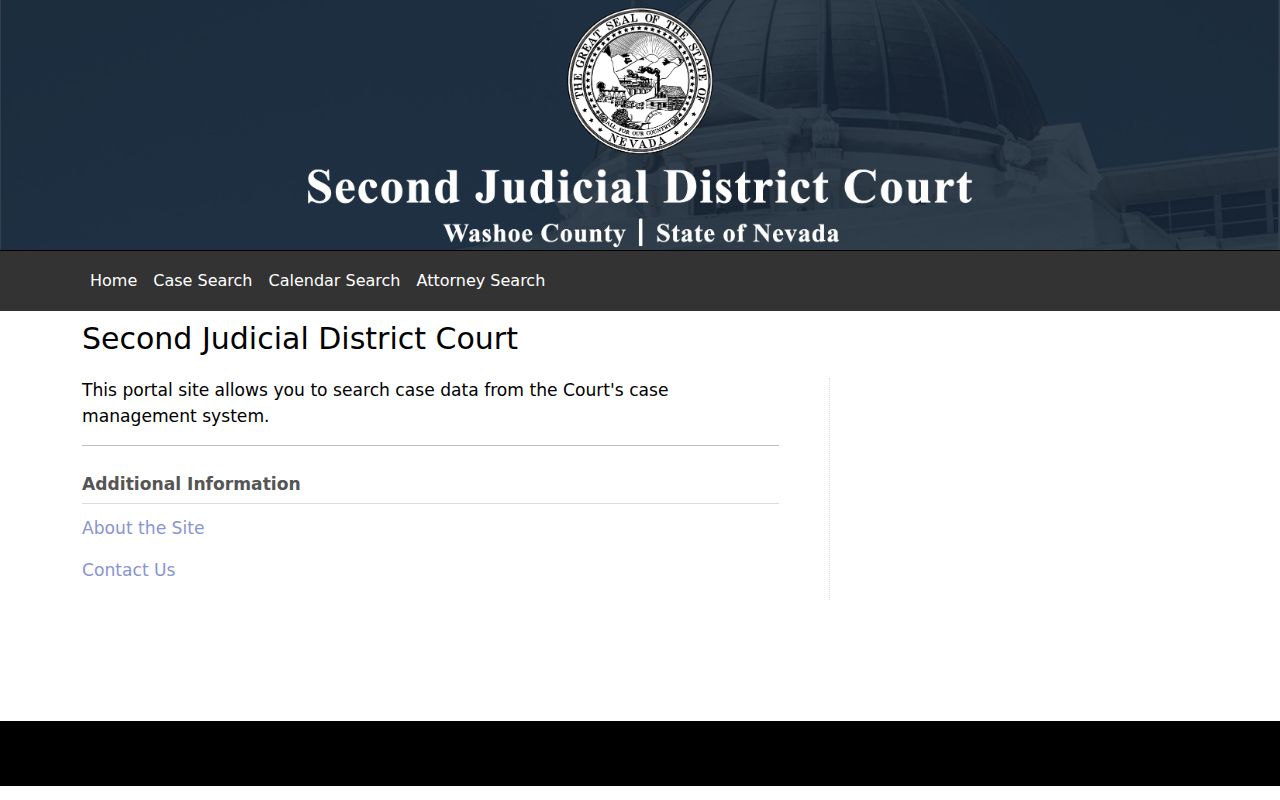
For a Washoe County resident lookup, use the screen to form a careful candidate list, then compare dates and roles in the individual docket.
A typical docket result can show the case number, caption, parties, filing date and type, hearing or event entries, docket descriptions, assigned department, and any available document links. Some public documents require a courthouse terminal or eFlex. Sealed, juvenile, adoption, expunged, and protected family material may not be available. The court's public terminals are at the Law Library on Court Street and the Resource Center on South Sierra Street. A result is an index record, not a certified disposition.
The Reno Municipal Court public portal is a separate route for case, citation, defendant, and attorney searches.
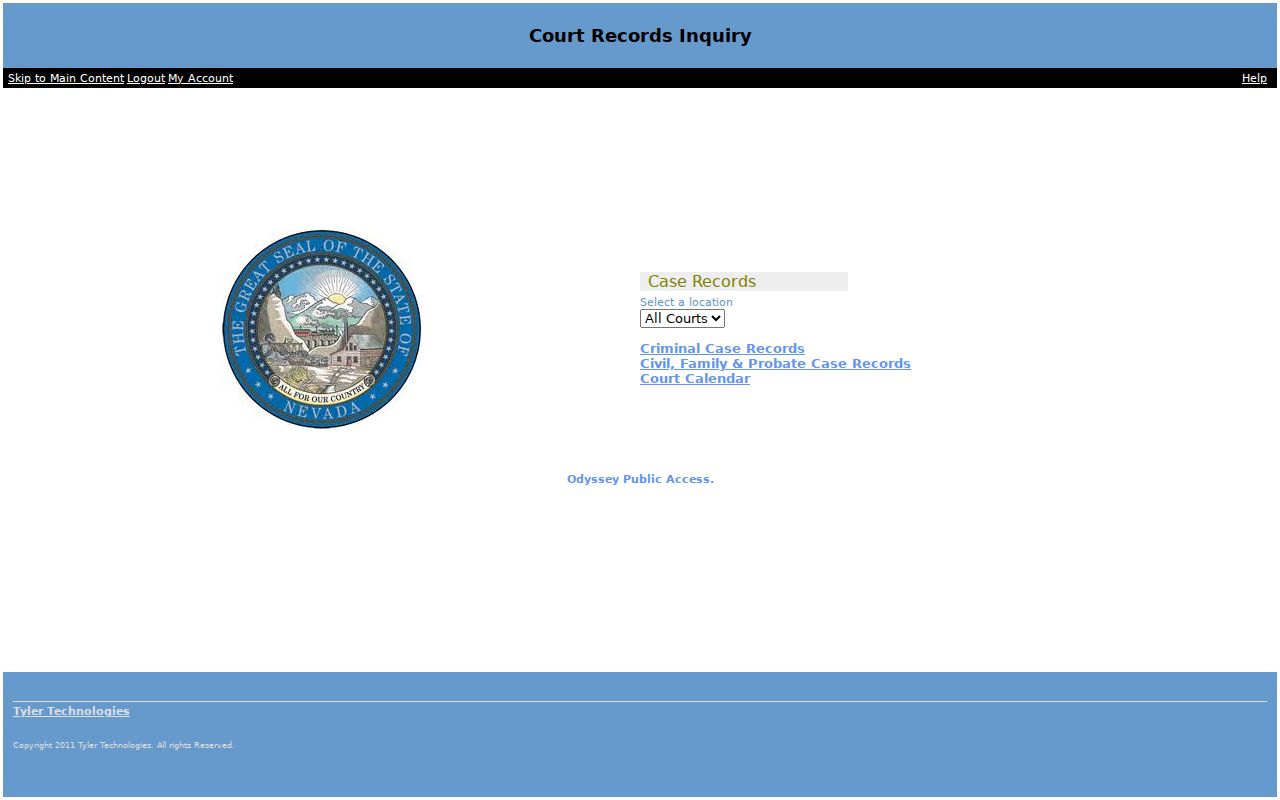
Its separate jurisdiction means a Washoe County resident lookup may need both court systems when the known event occurred in Reno.
Note: A court caption may identify a party, but it does not prove that person's current location, legal responsibility, or present status.
Washoe County Resident Name Matches
Common names create the largest avoidable error in a resident lookup. Require at least two independent points of agreement before treating two results as one person. Useful combinations include a middle initial with an address, a spouse or relative with a deed date, a parcel's legal description with a transfer date, or a court caption with the right city. A Recorder name search uses last name, then a space, then first name, with no comma. CAMA accepts a percent wildcard, such as J%Doe. Court search adds soundex and partial-name operators.
Compare the meaning of the field as well as the text. CAMA's situs is the physical parcel, while its mailing address is where tax correspondence goes and may be far away. A recorded instrument may name a trustee, lender, spouse, entity representative, or grantor. A business filing can establish an official filing role, not a home address. Keeping those distinctions intact prevents a plausible match from becoming a false identification.
The Nevada voter search is an individual confirmation tool, not a general name list. It asks for first and last name, date of birth, either a Nevada driver license or ID number or the last four digits of Social Security number, and a CAPTCHA.
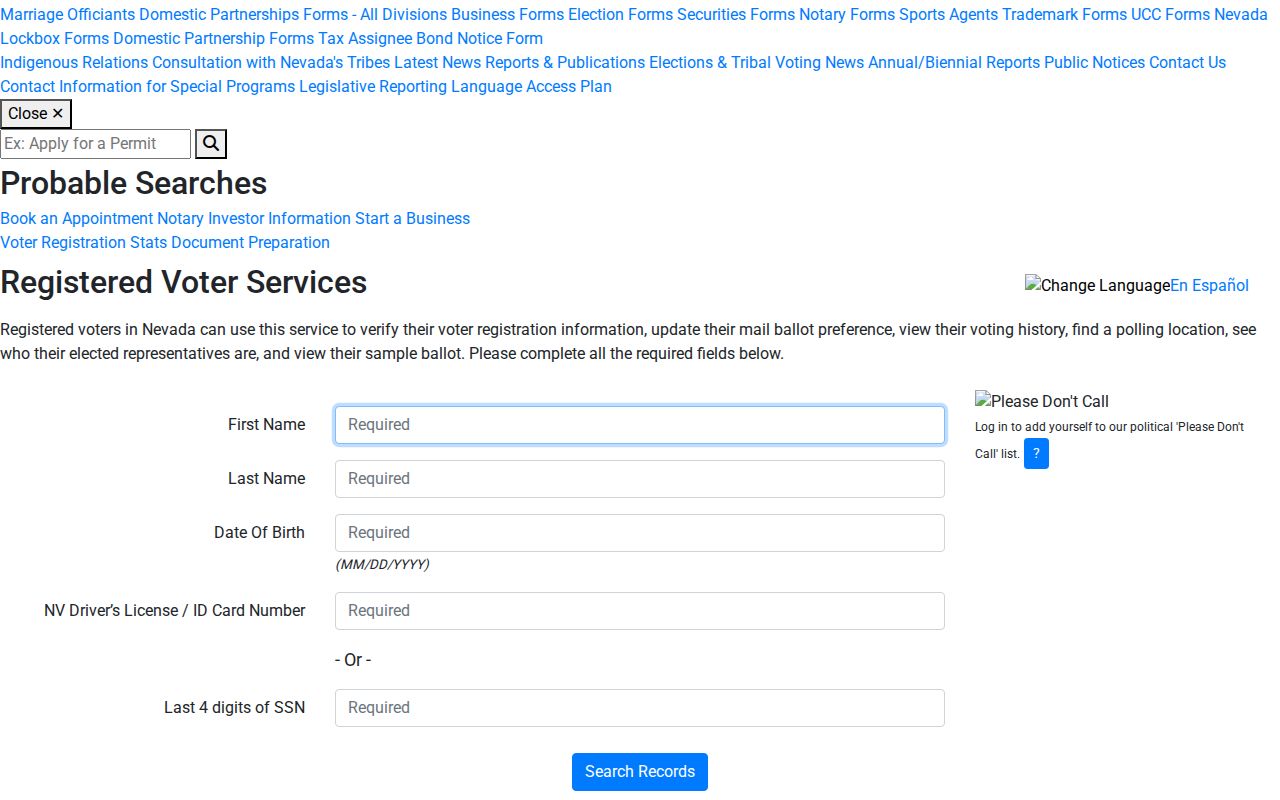
The required identity fields shown here make the voter route useful for a person who can lawfully verify their own registration, not for broad name collection.
Verify a Washoe County Resident
Verification works best when it moves from a specific association to an official record that explains it. For example, a person connected to a parcel can be checked against the transfer history, then a party-name case search can be limited by dates and name variants. If a certificate is needed for an estate or family matter, ask the vital-record custodian about eligibility before sending an application. Do not ask an office to conduct a broad people search. Give it the known name, date range, case number, document number, or parcel details instead.
- Use CAMA to capture the parcel number, situs, owner field, legal description, and last-transfer clue for a known address.
- Search the Recorder by party name and approximate year. Compare the deed's document number and legal description with the parcel before relying on it.
- Run the court party search with spelling variants and a date range. Open the docket rather than relying on the first result row.
- When a certificate or formal court copy is necessary, request it from the correct custodian and meet that office's proof rules.
- Docket
- The dated list of filings, hearings, and court events in one case. It is a chronology, not the full case file.
- Index and image
- An index is a searchable list of record details. An image is the document view, which can have a different online date range or copy rule.
- Certified copy
- A copy issued and certified by the custodian for an official purpose. A portal display does not replace it.
Keep the source labels separate in your notes. A parcel card, recorded deed, docket entry, and certified copy can corroborate one another, but each retains its own date, custodian, and access limit.
Washoe County Vital Record Paths
Birth and death records are not open resident lists. Northern Nevada Public Health is the Washoe registrar for local births and deaths, while the Nevada Office of Vital Records is the legal custodian for statewide certificates filed from July 1, 1911 forward. Under NRS 440.650 and NAC 440.070, a qualified applicant needs a direct relationship, legal relationship, or a need connected to a legal process. The state verification route costs $10, even if no record is found. Certified copies need identity and eligibility proof.
Marriage and divorce use different paths. The Recorder's marriage indexing follows records after 1965, while the state marriage/divorce search form covers the windows from June 1968 through September 2005 and from May 2015 forward. That $10 state search verifies an event, not a certified copy. Certified marriage copies come from the county Recorder where the license was purchased. A certified divorce decree comes from the court that granted it. For a local question, start with the Nevada vital-records custodian or Northern Nevada Public Health rather than treating an index entry as proof.
Older family research has a different fallback chain. The Washoe County Library has directories, telephone books, newspaper microfilm, obituary indexing, and staff assistance. UNR Special Collections holds digitized directories, yearbooks, and community materials. Those sources can corroborate a historical address or family connection, but they do not override a restricted certificate or sealed court file.
Note: A vital-record verification can confirm a search result for an eligible requester, but it does not bypass the certificate custodian's proof requirements.
Washoe County Resident History Trails
Some questions have an official route that is narrower than a general resident lookup. For an heir, the Second Judicial District Court Probate division can provide public case clues such as petitions, notices, inventories, and dispositions when they are available. Pair a probate case with an obituary, recorded estate document, and the docket dates. Heir details can be old or protected, so use the record to understand the estate rather than to assume current contact information.
Nevada's Adoption Reunion Registry is the proper path for an adult adoptee or birth parent seeking a mutual-consent connection. A notarized application can lead to the release of the matched participant's submitted contact details, but only if there is a match. Identifying adoption records remain sealed absent a court order under NRS 127.140. For a former classmate or historical resident, UNR, the library, yearbooks, newspapers, and obituary records offer a more fitting trail. A date in a directory or yearbook is historical evidence, not a present-day location.
Washoe County Record Request Fallbacks
When an online result ends, ask the particular custodian for the defined record rather than making a broad request. Nevada Public Records Act provisions NRS 239.010 and NRS 239.0107 generally require a response by the end of the fifth business day, or written notice explaining when a record will be available. Include the person name and variants, a narrow date range, and any parcel, case, or document number. State whether electronic delivery or paper is preferred.
The court has a records-search request form for name and year searches. Its published fee is 50 cents per name per year, paid in advance; copies and certification have separate charges. The Recorder provides older instruments through books and microfiche when its online property index does not reach the needed year. County guidance lists five cents per paper page for many county departments, but statutory or custodian-specific fees control for Recorder, court, and certified material. Ask for a redacted or non-identifying version when a full record is confidential.
Note: A precise request gives the custodian a fair way to find a record without turning protected information into a general resident search.
Washoe County Resident Lookup Privacy
Nevada public records law does not open every detail held by government. Voter records withhold Social Security, driver-license or ID, and email fields under NRS 293.558, and a voter can request address and telephone withholding. Nevada's Address Confidentiality Program protects qualifying survivors through a substitute address. Vital certificates require the eligibility rules noted above. Juvenile, sealed, expunged, adoption, and protected family material can be absent from a public court search. DMV addresses are restricted by the federal Driver's Privacy Protection Act.
The Recorder also cannot simply erase an official record. NRS 247.520 and NRS 247.540 provide a court-order path for certain protected people, and the order must identify document numbers. The Recorder's Recording Notification Service can alert a person to future recordings by name or parcel, but it is not an opt-out from the index. Where private commercial profiles repeat stale information, their removal processes are separate from the official custodian's correction process.
Lawful use. Use Washoe County resident lookup information for personal, family, estate, civic, or safety research. Never use a record to stalk, harass, threaten, or intimidate anyone.